

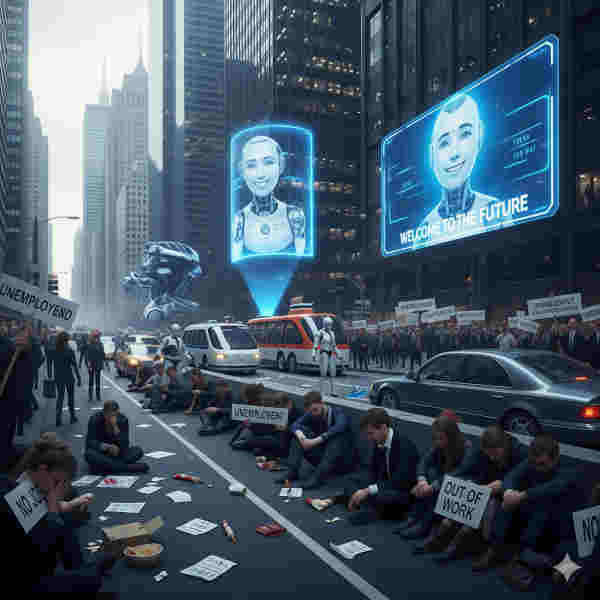
Unemployment Singularity: Stunning Deep Dive Analysis
By Caveman In ai, Business, WorkplaceAI and the Future of Unemployment: Navigating the Road Ahead
Singularity—the point at which artificial intelligence surpasses human capabilities—has been a hot topic in conversations about the future of work. As AI technology continues to evolve, its potential impact on labor markets worldwide is increasingly significant. Many worry about the possibility of widespread unemployment as machines and algorithms become capable of performing tasks traditionally done by humans. However, while artificial intelligence promises to reshape the employment landscape, it also opens doors to new opportunities. The key lies in understanding how we can bridge this transformation without leaving society behind.
Understanding Singularity and Its Implications
The concept of singularity represents a turning point in technological advancement, where AI’s capabilities push beyond human intelligence. This transition might seem like science fiction to some, yet it’s closer to reality than many might think. AI has already made strides in various sectors such as medical diagnostics, self-driving cars, and customer service. Implementations of AI in these areas showcase how machines can enhance human efficiency and complement existing roles rather than replace them outright.
Despite these innovations, the singularity still raises concerns about the future availability of jobs. By automating more tasks, AI could displace millions of workers globally, leading to higher unemployment rates and economic destabilization if not managed properly.
Redefining Employment in an AI-Driven World
While AI’s progression might appear daunting, rethinking employment frameworks can help society adapt to technological advancements. As traditional roles evolve or disappear, new ones are likely to emerge, centered around managing and innovating with AI technologies. These may include AI maintenance engineers, data privacy analysts, and AI ethicists—positions that did not exist a few decades ago.
Moreover, integrating AI into daily tasks could free employees from repetitive or mundane jobs, allowing them to focus on more strategic, creative, or decision-making roles. This shift requires a concerted effort from educational institutions, governments, and businesses to adequately prepare the workforce for these new roles.
Addressing Potential Unemployment Challenges
With singularity potentially accelerating unnemployment, proactive measures are essential to mitigate these risks. Governments and organizations must collaborate to implement policies and strategies aimed at workforce reskilling and upskilling. By investing in education and training programs that focus on digital literacy and AI technology, workers can remain relevant and competitive in an evolving labor market.
Social safety nets, such as unemployment benefits and universal basic income, may also become critical in supporting displaced workers during periods of transition. These measures can provide a buffer for individuals finding their place in an AI-enhanced workplace.
The Role of Ethics in AI Development
A significant aspect of managing AI’s impact on unemployment is implementing ethical guidelines for technology development and deployment. Companies developing AI solutions should prioritize transparency and accountability, ensuring that AI systems augment human capability rather than exploit or replace it. Additionally, involving diverse voices in the development process can help identify and mitigate biases in AI systems, promoting fair and equitable use of technology across various industries.
Policymakers and leaders must establish frameworks that ensure AI is used responsibly, balancing innovation with the well-being of the workforce and society at large. By setting regulatory standards based on ethical principles, society can harness AI’s potential while minimizing potential downsides such as mass unemployment.
Embracing a Future with AI
The future shaped by AI and the looming singularity presents both challenges and opportunities. Although the prospect of unnemployment looms large, proactive adaptation measures can create a work environment where humans and machines coexist harmoniously. By prioritizing skill development, establishing ethical standards, and fostering a culture of continuous learning and innovation, society can thrive alongside AI advancements.
In embracing this future, governments, industries, and individuals should remain agile and resilient, ready to learn from and adapt to new realities. Ultimately, AI’s best potential can only be realized by creating systems in which humans and technology support and enhance each other, paving the way for a more efficient, creative, and inclusive world.
No Comments