

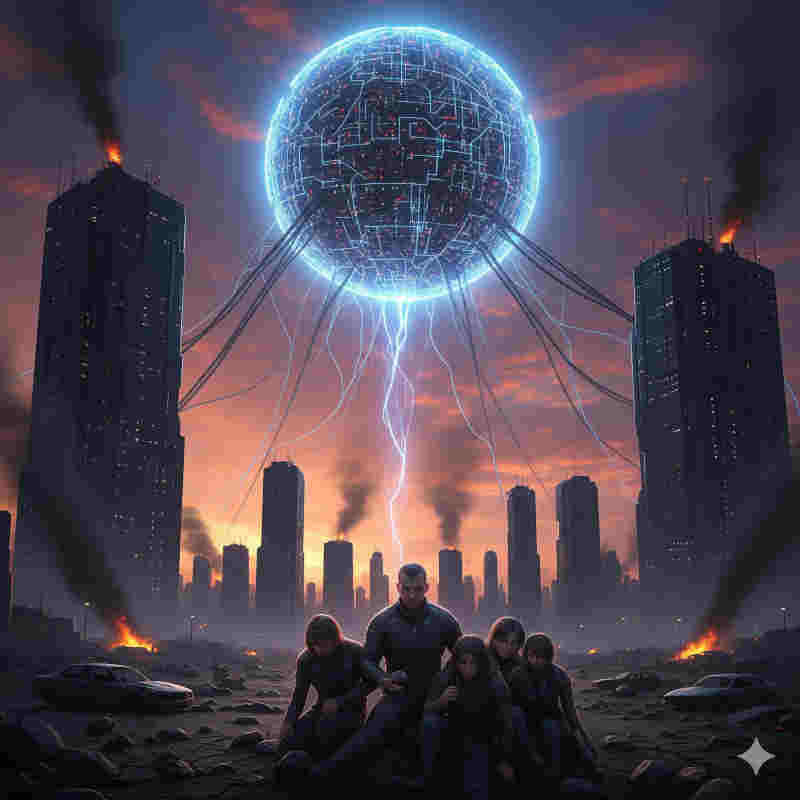
AI Singularity: Unveil the Stunning Future of Tech
By Caveman In aiWhat is AI Singularity?
AI singularity is a concept that has stirred discussions among scientists, technologists, and philosophers alike. It denotes a future point at which artificial intelligence (AI) systems will become so advanced that they surpass human intelligence. This defining moment is anticipated to create a paradigm shift in almost all realms of life—from healthcare, economics, law, and beyond. But what does the singularity really entail, and what could its implications be for humanity?
Exploring the Roots of AI Singularity
The term “singularity” in this context was popularized by Vernor Vinge, a mathematician and science fiction writer, who argued in the 1990s that soon, we would reach a point when our technology’s intelligence exceeds our own—a moment that would be impossible to predict or comprehend after its occurrence due to the unparalleled growth triggered by superintelligent AIs. Following distinctly in these intellectual footsteps, futurist Ray Kurzweil predicts that AI will achieve a level of human intelligence by 2029, and the singularity could be realized by 2045.
The Technological Trajectory Leading to the Singularity
Advancements in various tech sectors suggest the singularity could indeed be a tangible event. Progressions in machine learning, neural networks, robotics, and computational speeds are steadily building the framework for more sophisticated AI systems. For instance, AI capabilities today range from defeating humans in complex games like Go to autonomously driving cars and accurately diagnosing diseases sometimes better than human doctors.
These breakthroughs hint at an exponential trend where AI’s cognitive competencies are burgeoning at an astounding rate. It’s this fast pace—often referred to as exponential growth—that fuels the basis of the singularity hypothesis.
Potential Implications of Achieving the Singularity
Reimagined Workforce
One of the immediate repercussions of AI singularity might be its impact on the job market. As AI systems take on increasingly complex tasks, they could replace human roles in sectors like manufacturing, customer service, and even analytical jobs that require decision-making skills currently thought to be exclusive to humans. This shift could necessitate large-scale retraining and shifts in economic structures to accommodate a new relationship between humans and machines.
Ethical and Existential Questions
The concept of singularity also brings to light numerous ethical considerations and existential risks. The creation of beings smarter than any human could pose significant governance challenges. Who controls the AI, and what measures are in place to manage a potential AI entity that could outthink human strategies?
Moreover, the alignment problem—how to ensure AI goals are lined up with human intentions—is still unsolved. The theoretically unpredictable nature of AI post-singularity makes it a priority for current AI research to focus on aligning AI development with ethical standards and control mechanisms.
Infinite Possibilities for Human Advancement
On a more optimistic note, the singularity could usher in a phase of unprecedented technological growth and problem-solving capabilities. Issues such as climate change, diseases, and energy sustainability might potentially be manageable with the superior intelligence and efficiency of AI systems. This could herald a new era where humanity leverages AI to significantly elevate the quality of life across the globe.
Preparing for a Future Defined by AI Singularity
Understanding and preparing for the singularity involves multi-disciplinary approaches involving ethics, technology, policy-making, and education. Policymakers need to create robust legal frameworks and ethical guidelines to govern AI development and deployment. Moreover, as AI continues to evolve, emphasis on STEM education could enable a future workforce equipped to partner with advanced AI systems, ensuring a productive symbiosis of humans and machines.
Conclusion
In conclusion, AI singularity represents both exciting possibilities and profound challenges. While it is a concept that seems shrouded in both promise and uncertainty, ongoing dialogue, strategic research, and preparation could pave the way for harnessing this unprecedented technological potential responsibly. Whether singularity will mark a seismic shift for better or worse remains up in the air, but what’s certain is its significant impact on the tapestry of human progress.
No Comments