

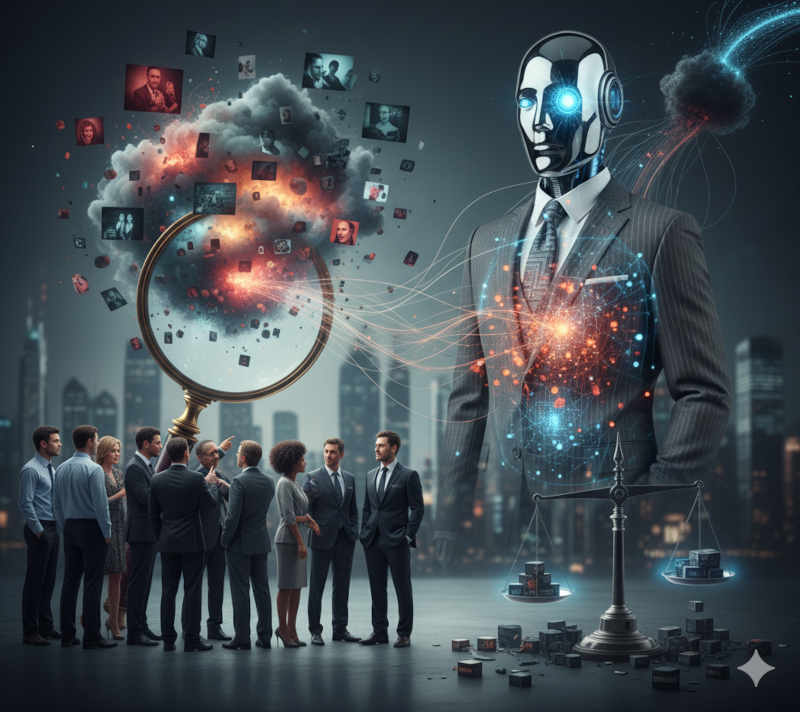
Human Bias and Artificial Intelligence
By Caveman In ai, TechnologyExcerpt (WordPress preview):
Bias is not just a personal flaw—it is the operating system of both human thought and artificial intelligence. From survival instincts to algorithmic training data, bias defines how narratives are created, spread, and used to shape power.
Meta Description (SEO):
Explore the roots of human bias, how AI inherits and amplifies it, and why control of narratives has become the ultimate form of power in the digital age.
Bias: The Human Operating System
Human beings like to think of themselves as rational, objective decision-makers. But psychology and neuroscience have shown otherwise. Cognitive biases—mental shortcuts hardwired into our brains—distort how we interpret reality.
- Confirmation bias: we actively seek evidence that supports what we already believe.
- Authority bias: we give weight to voices of perceived experts, even if they are wrong.
- Availability heuristic: we overestimate the importance of events that are easier to recall (like recent news or dramatic stories).
These biases are not accidents—they evolved as survival tools. In dangerous, uncertain environments, quick decisions mattered more than perfect accuracy. What once helped us avoid predators now influences how we vote, shop, and argue online.
The Transfer of Bias into AI
Artificial Intelligence doesn’t “think” independently—it learns from us. Large datasets filled with human choices, language, and cultural artifacts become the foundation for algorithms. That means our collective biases are encoded into AI systems:
- Data selection bias: What gets included—or excluded—in training data determines what an AI “sees.” If most historical medical studies feature men, AI-driven health tools may ignore women’s symptoms.
- Feedback loop bias: When AI systems suggest content, and users engage with it, the AI interprets this as “correct.” This reinforces existing biases rather than correcting them.
- Narrative bias: If dominant narratives saturate online spaces, AI models will learn and reproduce them, often marginalizing minority perspectives.
This is why AI outputs often “feel” biased—they are simply reflecting and amplifying the human biases embedded in their training.
Narrative as a Tool of Power
Throughout history, control of the narrative has been the cornerstone of power.
- Religious texts were used to unify kingdoms.
- State propaganda fueled wars.
- Media monopolies shaped 20th-century politics.
In the digital age, AI is the new amplifier of narrative power. Search engines decide what knowledge is “relevant.” Social media algorithms decide which voices are amplified. Generative AI systems decide what counts as a “plausible answer.”
The one who owns the data pipelines, algorithms, and platforms does not just reflect reality—they actively shape it. In effect, narrative control becomes reality control.
The Impact on Everyday Life
Bias in AI is not abstract—it affects daily decisions:
- Hiring: AI-driven recruitment systems can favor candidates from certain backgrounds if trained on biased company data.
- Finance: Credit scoring algorithms can reflect racial or geographic bias hidden in historical lending practices.
- Politics: Algorithmic recommendation systems shape public opinion by amplifying outrage and tribalism.
These are not just mistakes; they shift social and economic opportunities on a mass scale.
Living with Bias in the Age of AI
Neither humans nor machines can be fully objective. The path forward is not eliminating bias but managing it. This requires:
- Transparency: demanding explanations for how AI decisions are made.
- Diversity of inputs: ensuring datasets reflect a wide range of experiences and perspectives.
- Critical literacy: teaching individuals to question not only human media but also AI-generated content.
Bias is inevitable. But unchecked bias—especially when amplified by AI—becomes a weapon in the hands of those who control the narrative.
Closing Thought
Human bias built civilizations and destroyed them. Now, AI inherits this same flaw at global scale. The danger is not that bias exists—it always has—but that a small number of actors can weaponize it through AI systems to dominate narratives, and with them, power itself.
The ultimate question of our age is simple: Who owns the narrative? Whoever does, owns the future.
No Comments